Last Updated: January 15, 2026 | Specifically researched for female golfers
As golfers we all strive to be more consistent with our game – longer and more accurate off the tee, greater control with our short game, which club will get you over the water!
But generic golf distance charts are mainly based on static benchmark data. These numbers don’t always stack up for amateur golfers of different handicap and skill levels.
We’ve found this is especially the case for female golfers (mainly because those same generic tables are based on men!)
So we’ve created an interactive tool specifically for female golfers to solve that issue and give you more accurate information about your golf distances for each club in your bag.
For a full list of benchmark golf distance charts for amateur golfers try our new interactive tool where you can create your own printable club ditance table.
Average Golf Club Distance Charts for Amateur Female Golfers.
As a quick reference guide we’ve created an average golf distance chart for female golfers. Here are the benchmark numbers for our test female golfer who we’ve called “Sophie”.
Sophie’s Personal Details:
Age: 35 years old
Swing Speed: 82mph
Handicap: 16
Fitness Level: Average
Course Type: Mainly plays on parkland courses in the Spring & Summer.
Club Range: Driver to 7 Wood, Hybrid 4, 5-PW*, Wedges 52°-60°
Here are Sophie’s benchmark golf club distances:
| Club | Carry Distance | Total Distance | Notes for a 16 Handicap Female Golfer |
|---|---|---|---|
| Driver | 182 yards | 202 yards | For best results use a loft of at least 12° and a maximum of 14° |
| 3 Wood | 165 yards | 176 yards | Primary long-range weapon from the fairway. |
| 5 Wood | 154 yards | 163 yards | Excellent “second shot” club on long par 4s. |
| 7 wood | 145 yards | 152 yards | High launch club easier to hit consistently than a long iron |
| Hybrid (4) | 138 yards | 144 yards | Versatile for both tee shots and rough. |
| 5 iron | 128 yards | 134 yards | Often the most difficult iron to hit consistently. |
| 6 iron | 119 yards | 124 yards | Mid-range approach club. |
| 7 iron | 110 yards | 114 yards | A 7-is the “confidence” club for many amateurs. |
| 8 iron | 100 yards | 104 yards | Key scoring club for the 100-yard marker. |
| 9 iron | 91 yards | 94 yards | High trajectory, minimal roll. |
| PW | 81 yards | 83 yards | Usually the most used club for chipping too. |
| 52° Wedge | 72 yards | 74 yards | Full swing yardage for tricky distances. |
| 54° Wedge | 66 yards | 67 yards | Reliable for clearing greenside bunkers. |
| 56° Wedge | 59 yards | 60 yards | High loft, lands very soft. |
| 60° Wedge | 50 yards | 51 yards | Used primarily for short-sided lies off the green and brave flop shots! |
Notes on our Average 16 Handicapper Golf Distance Charts (Sophie)
-
The 80mph Baseline: An 80mph driver swing for a female golfer typically translates to a 64mph 7-iron swing. If your 7-iron speed is higher, adjust these carry numbers by +3 yards per 2mph of additional speed.
-
UK Summer Conditions: These figures are optimised for average UK summer humidity and temperatures. The combination of warmer air and firmer fairways allows the ball to travel further in the air while providing a higher bounce and longer “run” distances. However, remember that firmer greens require a higher landing angle (using clubs like a 7-wood) to stop the ball effectively.
-
The “Mid-Range” Adjustment: You will notice Sophie’s numbers sit at the upper end of our “Mid-Range” benchmarks. This is intentional: a 16-handicap with an 80mph swing has the physical capability of a “Long Hitter,” but we have accounted for the occasional off-center strike common in mid-handicap play to keep these averages realistic for on-course strategy.
Why Women’s Golf Distance Charts Are Different
This isn’t just a “men’s chart with lower numbers.
Women’s golf distances differ due to:
1: Swing Speed Differences
– Average LPGA Tour swing speed: 94 mph (driver)
– Average PGA Tour swing speed: 113 mph (driver)
– Average amateur woman: 60-70 mph (driver)
– Distance isn’t all about strength – it’s about biomechanics, club fitting, and technique
2: Equipment Considerations
– Women’s clubs typically have:
– Lighter shafts (45-55 grams vs 60-75 grams for men)
– More flexible shafts (L or A-flex vs R or S-flex)
– Shorter club length (1-2 inches shorter)
– Higher lofted drivers (12-14° vs 9-11° for men)
3: Strike Quality Focus
LPGA data shows women golfers often have BETTER strike quality than male amateurs at similar handicaps.
This means distances can be more consistent even with lower swing speeds.
Important: These charts are for women using women’s equipment. If you’re using men’s clubs, your distances may differ.
Data Sources for Women’s Golf Distances
This chart combines:
– LPGA Tour averages (2024-2025 season data)
– TPI women’s golf research (swing speed by age and skill level)
– Amateur women golfer surveys and obsverations from our 2024/25 Tour events
– Women’s equipment manufacturer specs (including: Callaway, TaylorMade, Ping women’s lines)
Our methodology is similar to that used for our popular amateur golfer distance charts here – Standard conditions at sea level, 70°F, calm wind.
How to Use This Women’s Distance Chart
Discover your true distances
Think of this as your personal on-course guide.
-
Tell us a bit about you – age, handicap, swing speed… whatever you know.
-
Pick the course conditions – whether the fairways are firm, soft, or just right.
- Download and Print – get a copy of your personal chart for your golf bag
-
See your distances in action – realistic numbers for every club in your bag.
-
Compare with the average – see how your game stacks up against other golfers like you.
Don’t worry if you don’t have every number on hand. We’ve added average data for typical female golfers so you can start immediately.
Pro tip: The more you update your personal info, the sharper your chart becomes. Think of it as your caddy that grows smarter the more you play.
Hit “Try it now” and get your personalised guide for every swing, every hole, every round!
Discover Your Personalised Golf Distances.
Our personalised distance charts calculate your ideal carry and total yardage using your age, handicap, fitness and swing speed — so you know exactly which club to pull with confidence on the course.
Try it now for your personal benchmarks…
Personalised Golf Distance Chart – Women
| Criteria | Input | Default / Average |
|---|---|---|
| Age (years) | 45 | |
| Handicap | 14 | |
| Swing Speed (mph) | 85 | |
| Ball Type | Standard | |
| Fitness | Average | |
| Fairway Conditions | Normal |
| Club | Benchmark Carry | Benchmark Total | Your Carry (Yards) | Your Total (Yards) |
|---|
Discover Your Personalised Golf Distances.
Our personalised distance charts calculate your ideal carry and total yardage using your age, handicap, fitness and swing speed — so you know exactly which club to pull with confidence on the course.
Try it now for your personal benchmarks…
Personalised Golf Distance Chart – Women
| Criteria | Input | Default |
|---|---|---|
| Age (yrs) | 45 | |
| Handicap | 14 | |
| Swing Speed (mph) | 85 | |
| Ball Type | Standard | |
| Fitness | Average | |
| Fairway | Normal |
| Club | Benchmark Carry | Benchmark Total | Your Carry | Your Total |
|---|
Download your personal chart, print it off, or save to your device for on-course reference.
Frequently Asked Questions: Women’s Golf Distance Charts
Here’s why women’s golf distances aren’t just men’s charts with lower numbers.
-
Swing Speed Matters: Average amateur woman drives 60–70 mph; biomechanics and technique are key.
-
Equipment Differences: Women’s clubs are lighter, more flexible, slightly shorter, and higher-lofted.
-
Strike Quality Counts: Many women hit the ball more consistently than male amateurs at the same handicap.
Age can reduce women’s golf distances gradually due to changes in strength, flexibility, and swing speed.
However, many women maintain strong distances into their 50s and 60s by improving technique, using properly fitted clubs, and focusing on mobility accuracy and fitness rather than raw power.
Yes – our golf distance calculator and charts are suitable for female golfers of all ages and skill levels.
Most calculators fail junior golfers entirely or treat them as “short-hitting adults.”
We have dedicated algorithms for:
- Ages 8-11: 70% of adult distances with development weighting
- Ages 12-16: 85% of adult distances with strength progression
Why this matters:
Proper distance expectations help junior golfers:
- Select appropriate tees
- Build confidence
- Develop course management skills
- Avoid frustration from unrealistic expectations
These numbers may need adjusting for longer hitting juniors future versions of the tool will account for this variable but in this launch edition you may need to add years on to the variable table to make allowances.
Here are 3 quick ways female golfers can improve their average distances:
1. Strike Quality First
– Women often have smoother swings than men = potential for better contact
– Focus on center strikes before chasing speed
– Use impact spray or clubhead stickers to check contact point
2. Equipment Optimisation
– Proper shaft flex clubs for your swing speed (most important factor)
– Driver loft (12-14° for most amateur women)
– Hybrid replacements for long irons
– Get fitted by specialist who understands women’s golf
3. Fitness & Flexibility
– Core strength (rotation power)
– Flexibility (especially shoulders and hips)
– Golf-specific exercises, not bodybuilding
– Many LPGA players aren’t “strong” but generate great speed through flexibility
4. Technique Improvements
– Proper weight shift
– Full shoulder turn
– Efficient swing path
– Lessons from instructor experienced with women golfers
Real results:
Fun Fact: Data shows that the average woman golfer can add 10+ yards to all clubs through better equipment and strike quality = 3-5 strokes per round improvement!
According to our Pro Panel it depends more on your swing speed, not your gender.
Use ladies flex shafts (L) if:
– Driver swing speed under 60 mph
– Can’t consistently carry driver 150+ yards
– Regular flex feels too stiff/heavy
Use senior flex shafts (A) if:
– Driver swing speed 60-75 mph
– Carry driver 150-180 yards
– Want more launch and forgiveness
Use regular flex shafts (R) if:
– Driver swing speed 75-85 mph
– Carry driver 180-200+ yards
– Generate good clubhead speed
Pro Tip: Get fitted: Don’t assume – get launch monitor data and proper club fitting.
For most women golfers: YES.
Women’s clubs offer:
- Lighter overall weight (easier to swing, less fatigue)
- Shorter length (better control, more consistent contact)
- Appropriate loft (optimized launch for slower swing speeds)
- Proper grip size (smaller hands = smaller grips)
When men’s clubs might work for female golfers:
– Swing speed over 80 mph
– Taller than 5’9″
– Athletic background with power
– Consider properly fitted men’s clubs (custom length/flex)
Bottom line: Equipment should match YOUR swing and characteristics, not your gender.
This personalised golf distance calculator has been created specifically for female golfers:
-
Based on professional benchmark data for women golfers.
-
Adjusts for age, handicap, swing speed, fitness, ball type, and course conditions.
-
Provides realistic distance estimates, far closer to on-course results than generic charts.
-
Accuracy depends on correct input, but it’s designed specifically for women’s equipment and average female swing speeds.
The average driver distance for women golfers is between 150 and 200 yards.
Most amateur players hit drives around 150–170 yards, while lower-handicap and more experienced women often reach 180–200 yards, depending on swing speed, strike quality, and equipment
You can use our interactive tool above to discover your personalised yardages guide, or use our popular golf distance calculator based on up to seven different shot variables here.
General advice from our Pro Golfer Panel is that you should review your distances whenever your swing speed, fitness level, equipment, or playing conditions change — or at least once per season.
Many golfers also choose to recheck distances after lessons, strength training, or switching golf balls.
Our advice from organising hundreds of amateur golf events for thousands of golfers is that you should play tees that match YOUR distances, not your pride!
Here’s our golf tee selection guide:
– Championship tees: 210+ yard 5-wood carry
– Back tees: 190-210 yard 5-wood carry
– Middle tees: 160-190 yard 5-wood carry
– Forward tees: 120-160 yard 5-wood carry
– Most forward: Under 120 yard 5-wood carry
Why this matters:
Course architects design holes based on expected distances:
– Par 4s should be driver + mid iron
– Par 3s should be mid iron to hybrid
– Par 5s should be reachable in 3 shots
General Guide: If you’re hitting driver + 3-wood on every par 4, you’re playing the wrong tees. Move forward = more fun, better scores, proper challenge.
Why we created golf distance charts for women…
As mentioned above whilst researching this article we found most online golf distance charts tend to focus on male golfers.
So we thought it would be useful to drill down into specific distances that would helpful to women amateur golfers.
If you don’t want to use our inactive golf distance calculator for female golfers above we’ve also created some benchmark tables for women by age, handicap level and swing speeds.
So we talked to our Professional coaching friends plus did some research from our own golf events and experience to create the benchmark tables below.
To further personlise the result we also broke down average swing speeds and golf club distances for women by age and by how far you generally strike the ball.
For fun we also compare amateur golfers against players on the LPGA to see how distances differ!
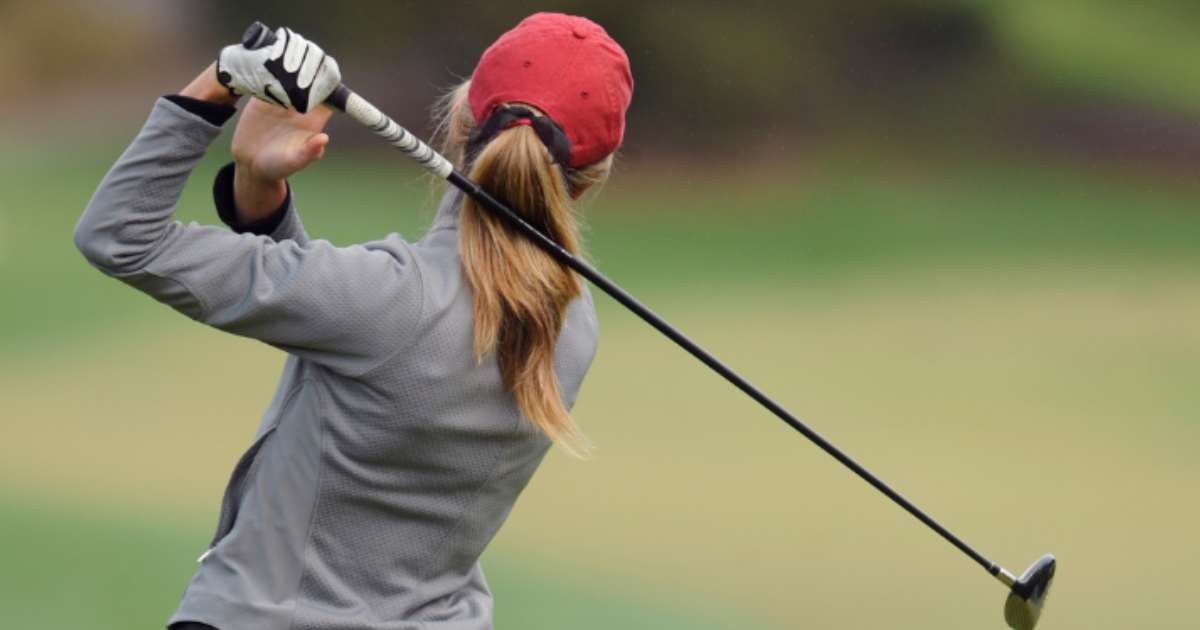
Why female golfers have better potential to shoot lower scores.
There are several factors that impact on how far we each hit any given golf shot including:
- Gender
- Skill level
- Technique
- Swing speed
- Club to ball contact
- Equipment – including golf ball
- Weather & ground conditions
- Ground lie
As a very general rule women tend to hit the ball slightly shorter distances than men, but the great leveller of golf is that it’s not always the player who can hit the furthest who wins the day!
Accuracy, and how you plot your way around a golf course, are also key to shooting lower scores.
Pro golf coaches told us that while female golfers tend to have slower swing speeds than men they do tend to be more accurate and consistent meaning they have a greater potential to shoot lower scores if all other factors are equal.
Go Straight to the Numbers!
Just interested in the distances not the science behind them?
No problem! – click the buttons below and you’ll be taken straight to the numbers!
Golf Swing Speeds for Women.
As you can see from the table below swing speed can be quite dramatically impacted by age with approximately a 20mph loss in speed for women between the ages of 40 and 60.
Since launch analysis tools like Trackman came onto the market swing speed has become a popular metric (and ego-boast!) for some (mainly male!), amateur golfers.
However, our discussions with pro-golf coaches suggest that for the majority of club golfers, regardless of gender, a bigger differentiating factor is the quality of strike and correct technique.
For example if you put an LPGA pro golfer and an average distance male amateur on a driving range they may have very similar swing speeds, but the ladies will hit the ball much further due to the quality of their ball striking.
That being said it’s good to have a rough idea of swing speed if you’re looking to improve your golf game.
So as a benchmark guide we’ve put togther data on average golf swing speeds for women in four age categories.
| Age | Average Swing Speed |
|---|---|
| 30 – 40 | 90 mph |
| 41 – 50 | 88 mph |
| 51 – 60 | 73 mph |
| 60+ | 70 mph |
Golf Club Distance Charts for Women 30 – 60 years old:
For ladies aged between 30 and 60 we have included three distance categories which take into account all the different vairables that go into a golf shot.
We’ve also included average club distances for LPGA Tour Pro’s.
See how you compare!
| Club | Short Hitter | Mid Range | Long Hitter | LPGA Tour Pro |
|---|---|---|---|---|
| Driver | 150 – 175 yards | 175 – 200 yards | 200 – 230 yards | 240 – 280 yards |
| 3 Wood | 125- 135 yards | 150 – 170 yards | 180 – 210 yards | 195 – 217 yards |
| 5 Wood | 110 – 120 yards | 135 – 145 yards | 170 – 200 yards | 185 – 205 yards |
| Hybrid | 105- 115 yards | 130 – 135 yards | 165 – 195 yards | 180 – 200 yards |
| 3 iron | 100 yards | 125 – 130 yards | 160 – 185 yards | 175 – 195 yards |
| 4 iron | 90 yards | 120 yards | 150 – 180 yards | 170 – 185 yards |
| 5 iron | 80 yards | 110 yards | 140 – 170 yards | 160 – 175 yards |
| 6 iron | 70 yards | 100 yards | 130 – 160 yards | 150 – 165 yards |
| 7 iron | 65 yards | 90 yards | 120 – 150 yards | 140 – 155 yards |
| 8 iron | 60 yards | 80 yards | 110 – 140 yards | 130 – 145 yards |
| 9 iron | 55 yards | 70 yards | 95 – 130 yards | 120 – 135 yards |
| Pitching Wedge | 50 yards | 60 yards | 80 – 115 yards | 110 – 120 yards |
| Gap Wedge | 45 yards | 55 yards | 85 – 95 yards | 100 – 110 yards |
| Sand Wedge | 40 yards | 50 yards | 60 – 85 yards | 90 – 95 yards |
| Lob Wedge | 35 yards | 45 yards | 50 – 70 yards | 80 – 85 yards |
Golf Club Distance Charts for Women Over 60:
For ladies over the age of 60 swing speeds tend to be around 70mph.
Our club distance charts are divided into two different age groups which will hopefully be useful in benchmarking your own game.
Please remember these distances are meant as a guide. To get a more accurate reading for your own golf shots you should speak to your club professional.
| Club | Mid Range 60-70 yo | Mid Range 70-80 yo |
|---|---|---|
| Driver | 140–180 yards | 120–160 yards |
| 3 Wood | 120–160 yards | 100–140 yards |
| 5 Wood | 110–145 yards | 80–120 yards |
| Hybrid | 115 – 135 yards | 85 – 115 yards |
| 3 iron | 100–130 yards | 90–130 yards |
| 4 iron | 90–130 yards | 80–120 yards |
| 5 iron | 80–120 yards | 70–110 yards |
| 6 iron | 70–110 yards | 60–100 yards |
| 7 iron | 60–100 yards | 50–90 yards |
| 8 iron | 50–90 yards | 40–80 yards |
| 9 iron | 40–80 yards | 30–70 yards |
| Pitching Wedge | 30–70 yards | 20–60 yards |
| Gap Wedge | 20–60 yards | 10–50 yards |
| Sand Wedge | 10–50 yards | 10–40 yards |
| Lob Wedge | 10 – 40 yards | 10–30 yards |
Understand your own game & see your scores drop.
These charts hopefully give you a guide and some benchmarks you can use to see how you match-up against golfers in your age group and skill level.
If you want a personalised distance chart please try our interactive calculator which takes your details and instantly creates an accurate printable chart based on real golf data not generic guesswork.
Remember swing speed and huge shot distances are not the keys to unlocking better scores for most amateur golfers.
In our experience female golfers are less concerned about the “macho metrics” of swing speed and distance. As a result woman tend to have much better golf swings and are far better at plotting their way around the golf course avoiding errors and hazards with more consistant and creative shots.
That’s why having confidence in how far you hit each club often produces lower scoring than someone who can scream 290 yard drives off the tee, but has no idea where it will land or in which direction!
Play your own game, the way you want to play it – you’ll have more fun on the course, and better scoring will follow.
We hope you found these golf distance tables useful – enjoy your golf!

Our tips for woman wanting to improve their golf club distance
Set yourself realistic targets: If you want to improve your hitting distances try to do it in small chunks rather than one go. For example if your average drive is below 150 yards but you want to consistantly hit that target try to improve by 3-5 yards at a time – this way you’re achieving your goals you’ll feel like you’re making progress towrds your main objective.
Don’t be afraid to hit the ball: It sounds simplistic but a lot of our coaching friends say that a common mistake their female clients make is that they hold back on impact when striking the ball. Try hitting through the ball a little harder on the practice range and see if that gives you better distance control. This doesn’t mean changing a smooth swing or head position it just means forcing your hands through a little quicker before you hit the ball.
Focus on fitness: Keep to a regular exercise and stretching routine to help build your strength, flexibility, and overall fitness levels. This can positively impact your swing speed and club distances.
Get the right equipment for you: Check your golf clubs and to a lesser extent the ball you use are suitable for your swing speed and skill level. We recommend speaking to your club pro or a professional club fitter to determine the best shaft flex, clubhead design, and loft angles for your game.
Warm-up and stretch: Whatever your age, to maximise your golf performance it’s vital you warm-up before each round or practice session. This prepares your muscles and joints, improving your swing and reducing the risk of injury. There are plenty of resources online that demonstrate warm-up exercises and stretches designed for golfers of all ages. Here are 5 quick and easy golf warm-up drills you can do before your round.
Practice Practice and a bit more practice!: Hone your skills with regular practice sessions to help develop technique and muscle memory. We all know golf can be a hugely frustrating game, but the more you practice the more likely you’ll be able to hit consistent golf shots with each club. This consistency will give you more confidence next time you stand over a 145 yard approach shot into the 18th with a match all square! Good luck and enjoy your next round!
About This Guide for Female Golfers
Created by golfers for golfers. Our team has over 75 years combined golf experience, plays hundreds of rounds annually across all parts of the golfing globe, and has tested equipment with launch monitors to validate these numbers.
Due to the popularity of these charts with our golfing community we will be updating this resource regularly because equipment and swing technology evolves.
How We Created These Distance Charts
These distance charts are designed specifically for female golfers.
We combine data from multiple authoritative sources to provide the most accurate baseline expectations for amateur female golfers:
Primary Data Sources:
– LPGA Tour averages (2024-2025 season) for professional benchmarks
– TPI (Titleist Performance Institute) swing speed research across age groups, genders, and skill levels
– Equipment manufacturer specifications from major brands (club loft standards, shaft lengths)
– Amateur golfer research from our golf travel community
Testing Conditions (Standard Baseline):
All distances assume:
– Sea level elevation (0-500 feet)
– 70°F (21°C) temperature
– Calm conditions (wind under 5 mph)
– Moderate humidity (40-60%)
– Firm fairways with normal roll
Why Conditions Matter:
Your actual distances will vary based on:
Altitude: +2% per 1,000ft (Denver: add 10%)
Temperature: -2 yards per 10°F drop below 70°F
Wind: 10 mph headwind = -5 to -10 yards
Course firmness: Soft conditions = less roll
Ball type: Premium vs range balls = 5-10 yard difference
Our Update Schedule:
We review and update these charts twice annually (January and July) to reflect:
– Equipment technology changes (new club releases)
– Swing data trends from professional tours
– Community feedback from golfers using our charts
– New research from golf performance institutes
Popular Distance Resources from Greencard Golf
Detailed Distance Guides:
- Our New Interactive Golf Distance Calculator
- Complete Golf Distance Charts (All Demographics)
- Senior Golfer Distance Charts (60+)
- Golf Distance Charts Personalised by Handicap
Individual Club Guides:
YOU MIGHT ALSO BE INTERESTED IN…