
Why a 7-Wood is the Secret for up to 14 More Yards
A golfer stands 190 yards out, pulls a 4-iron… and watches the ball fall 20 yards short, usually into sand or water.
Moments later, their playing partner reaches for a 7-wood — and hits a higher, longer shot that lands softly on the green with far more control.
Same distance. Same swing. Very different result.
Here’s why:
Although a modern 4-iron and 7-wood may both have 21° of loft, they are built to perform very differently for amateur golfers.
Our ne interactive distance tool shows many players gain up to 15 yards of carry simply by switching from a long iron to a 7-wood — without swinging harder or faster.
👇 Use the calculator below to see the distance gap in your own bag.
Discover How Many Yards a 7-wood Could Add to Your Long Game?
Most mid to high handicap golfers are shocked by how many yards carry they can get from a 7 wood versus long irons.
Find out your own potential distances with our distance tool based on your individual details and course conditions.
Step-by-Step Guide: How to use our distance calculator tool
- Enter your personal details (age, handicap, etc.)
- Select current course conditions
- View your customized distances
- Compare against benchmark averages
Don’t worry if you don’t have the exact numbers or details for some of the variables such as your swing speed or type of golf ball to hand.
We’ve pre-loaded some average benchmark data for a typical amateur golfer which the tool will use until you have your own personal inputs.
Try it now for your personal golf distance benchmarks…
.
Personalised Golf Distance Chart – 7 Wood
| Criteria | Input | Default |
|---|---|---|
| Age (years) | 45 | |
| Handicap | 14 | |
| Gender | M | |
| Swing Speed (mph) | 95 | |
| Ball Type | Std | |
| Fitness | Avg | |
| Fairway | Norm |
| Club | Bench Carry | Bench Total | Your Carry | Your Total |
|---|
Why the 7-Wood Often Outperforms Long Irons
The “magic” behind the 7-wood’s 15-yard advantage isn’t luck—it’s by design.
Here are the five features that turn difficult long-iron shots into effortless sweeps:
-
Natural Speed: The longer graphite shaft creates more leverage and clubhead speed than a 4-iron.
This additional “whip” will naturally create more speed without any extra effort in your swing. -
High-Launch Gravity: A lower Center of Gravity (CG) launches the ball higher.
While a 4-iron requires a perfect strike to get airborne, the 7-wood sweeps the ball upward even on thin hits. -
“Hotter” Face Technology: Unlike solid iron faces, fairway woods feature flexible faces that act like a trampoline.
You maintain ball speed and distance even on off-center mishits. -
Steep Descent (Stopping Power): Flying 6–10 yards higher than a 4-iron, the 7-wood lands at a much steeper angle.
This “drop-and-stop” flight allows you to hold the green on long par-3s rather than rolling off the back. -
Turf Interaction: The wide, rounded sole glides over the grass.
Where a 4-iron digs into the rough and twists, the 7-wood acts like a rudder, staying square through the heaviest lies.
The Bottom Line: The 7-wood replaces low-percentage iron strikes with a high-launch, high-confidence fairway sweep.
If you want to stop “surviving” long approach shots and start attacking them, the data says it’s time to make the switch
Possibly the Most Trusted Club in Your Bag?
There used to be a bit of stigma about carrying lofted fairway woods in your golf bag.
Anything beyond the standard Driver, 3 wood and 5 wood was seen as “giving in”
Tell that to the guy still slicing a 3 iron 100 yards onto the next fairway!
I became a convert a last year, and am proud to own my love of this wonder club!
Over the past couple of seasons the 7-wood has become a trusted club for many golfers – both pros and amateurs, who are looking for a perfect balance of distance and forgiveness.
But how far should you be hitting this game-changing club?
This article explores the average 7-wood distances for different categories of golfers—men and women, aged 30–60 and 60+, and compares these to the impressive distances achieved by professional golfers. We’ve even listed our top picks of the 7 woods currently on the market.
But before we go any further watch the short video below and hear how Ludwig Aberg used his 7 wood to set up eagle at Pinehurst last year which he hit from 290yards to 9 feet!
Look out for the face his caddie pulls after the ball rolls up to the hole!
The Benefits of a 7 wood for Amateur Golfers
OK so the 7 wood might be popular but what makes it so special, and why should you swap it for your long irons?
1: A 7 wood has a higher launch angle and more forgiving nature which make it a go-to club for mid-range shots, tricky lies, and softer landings on greens.
2: Long irons, such as 3- and 4-irons, can be difficult for amateurs to hit consistently due to their smaller sweet spots and lower launch angles. 7 wood designs vary, but from a size perspective, 7-woods range from about 145 to 160 cubic centimeters, which is approximately one-third the size of a driver. This gives it a larger hitting area than hybrids and long irons.
3: Golfers who struggle with hybrids, often find a 7-wood feels more comfortable to swing.
4: A 7-wood is a favourite amongst amateur golfers because it is a true multi-purpose club.
- Off the Tee: Great for short par-4s or tight tee shots where precision is key.
- From the Fairway: Its high launch makes it ideal for long approach shots into greens.
- In the Rough: The club’s sole design helps it glide through rough more effectively than long irons or hybrids.
- Recovery Shots: Its ability to hit high, soft-landing shots is invaluable for navigating hazards or trees.
5: The 7-wood has become especially popular among seniors, women, and high-handicap golfers, who tend to have slower swing speeds. Its loft and design help maximize carry distance, even with moderate swing speeds. Plus the higher ball flight, gives players the stopping power needed for approach shots on long par-3s or par-5s.
What’s the Difference Between a 7 Wood and Hybrid?
A 7 wood falls into the golf club category of a fairway wood.
So the main diference between 7 woods and hybrid clubs comes in construction and design.
Fairway woods have a larger hitting area, a wider sole and a centre of gravity that is set lower and farther back.
This is what makes fairway woods more forgiving, and helps golfers of all skill levels hit the ball more consistantly higher into the air.
It also makes fairway woods like a 7 or 9 wood easier to hit from thick rough.
Finally, compared to a hybrid or an iron, 7-woods typically have a longer shaft, allowing a player to generate more clubhead speed and power.
Kenton Oates a Ping PGA Tour representative sums it up perfectly.
“The 7-wood is just such a forgiving golf club,” Oates said. “Hybrids are more forgiving than a 4-iron, yes, but if you put a hybrid and a 7-wood down together, you see how much bigger the 7-wood is back to front. The center of gravity is so much lower. It’s just a more-forgiving golf club.”
7 Woods Aren’t Just For Amateur Golfers
But it’s not just amateur golfers who are finding the 7 wood a great club to have in their bag.
Many Pro’s are also turning to this club when they need consistancy and accuracy – including two of the most successful golfer of 2024 – Masters and Open Champion Xander Schauffele and LPGA wonder Nellie Korda!
Just take a look at some of the pro’s who make sure the 7 wood is a key part of their on-course tool-set.
Pro’s who have a 7 wood in their bag
Which 7 woods do tour pros use?
Here are some of the Pro’s who have been known to carry 7 woods in their bag over the last few of seasons and the clubs they may have been using:
- Xander Schauffele, Mavrik SZ 7-wood
- Joaquin Niemann, Ping G425 Max 7-Wood
- Ludwig Aberg, TaylorMade Stealth 2 7-Wood
- Adam Scott, TaylorMade Stealth 7-Wood
- Nellie Korda, TaylorMade Stealth 2 7-Wood
- Tyrrell Hatton, Ping G430 Max 7-Wood
- Dustin Johnson, TaylorMade Stealth 7-Wood
Now let’s talk distances…
Average 7-Wood Distances for Amateur Golfers
As with any other club different golfers will hit a 7 wood varying distances.
The final result depends on factors like swing speed, age, gender and equipment. (click here to see our full article on the factors influencing golfers distance with each club)
To make our 7 wood distance charts for amateur golfers as useful as possible for as many golfers as we can, we’ve broken down the distance charts into several categories:
- Age
- Gender
- Hitting distance
We’ve included a range of distances due to variables such as club loft, swing speed, ball contact plus weather and ground conditions (obviously a ball hit onto a hard and dry fairway will run further than that on a windy and wet course in winter).
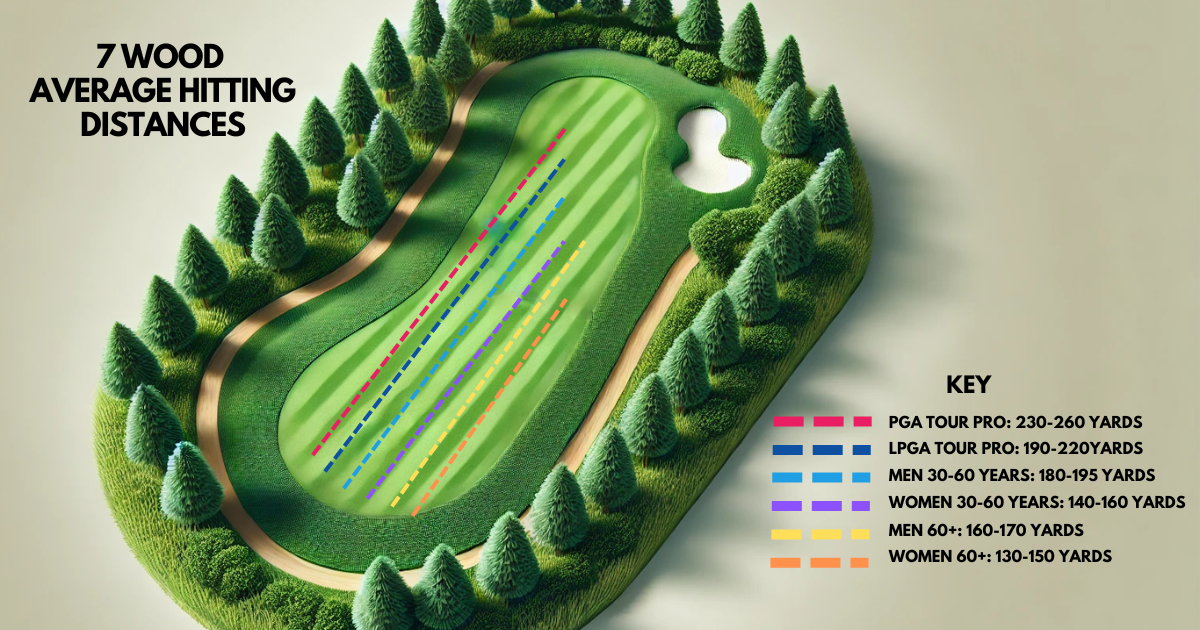
| Golfer | Short Hitter | Mid Range | Long Hitter |
|---|---|---|---|
| Men (30–60 years) | 145–170 yards | 180–195 yards | 200–210 yards |
| Women (30–60 years) | 110–130 yards | 140–160 yards | 170–190 yards |
| Men (60+ years) | 135 – 150 yards | 160 – 170 yards | 180 – 190 yards |
| Women (60+ years) | 120–140 yards | 130–150 yards | 140–160 yards |
How Far Do Tour Pro Golfers Hit a 7 wood?
The figures for the Tour Pros are quite staggering – they are hitting on average 55+ yards further than our mid-range club golfers!
Makes you very thankful for the leveller that is the golfing handicap system!
| Golfer Category | 7 wood Range of Distances | Average Distance |
|---|---|---|
| PGA Tour Professionals | 230–260 yards | 245 yards |
| LPGA Tour Professionals | 190–220 yards | 205 yards |
Why are 7-woods gaining popularity with Pros?
The Pros don’t care what people think about the clubs they hit what matters is the result!
And the new 7 woods consistently deliver.
J.J. Van Wezenbeeck, Titleist’s director of players promotions puts it down to better design meaning less spin on the ball.
A decade ago, 7-woods generated far too much spin for fast-swinging pros to have them in the bag.
Today, however, manufacturers have dramatically reduced spin generated by fairway woods. Plus the extra loft in a 7-wood makes it easier to get the ball high into the air and bring it down more vertically, so it stops quicker on the super-fast greens the Pros have to tackle.
“We have been able to add so much ball speed to our fairway woods that going up in the loft allows us to have a higher launch and control the yardage,” Van Wezenbeeck told GolfWeek magazine recently.
Kenton Oates also said pros are turning to 7-woods because when they mis-hit a hybrid, they tend to go left and lose distance.
If they mis-hit a 7-wood, the ball typically goes nearly as far, but stays straighter minimising scorecard impact.
“Even when they pull it, they are still going to see that 240 number or whatever the guy wants over and over and over again,” he said.
Frequently Asked Questions: 7 Wood Distances
For the average amateur golfer, a 7-wood typically carries 10–15 yards further than a 4-iron.
While they share similar lofts of 21 degrees, the 7-wood’s longer shaft and hotter face technology produce significantly more ball speed.
Additionally, the higher launch of a 7-wood ensures the ball stays in the air longer, maximizing carry distance that a low-launching long iron often leaves behind.
Most golfers find the 7-wood easier to launch than a 3-hybrid.
As our distancce calculator tool shows the design of the 7-wood means shots will generally fly further.
Because the 7-wood has a larger head and a more “sweeping” sole, it is more forgiving from the fairway.
However, if you find yourself in the thickest rough frequently, a hybrid’s smaller profile may have a slight edge.
Absolutely. In fact, high-handicappers benefit the most.
The wide sole prevents the club from “digging,” which reduces the risk of heavy fat shots.
The high forgiveness factor of a 7 wood design also means that even if you strike the ball off the toe or heel, the clubhead resists twisting, keeping your shot much straighter than a traditional long iron would.
To get the most out of a 7-wood’s high-launch design, you need a ball that balances spin and speed.
While many players reach for a Titleist Pro V1, there are several high-performance options that offer better value or specific flight characteristics.
If you are looking for the right match for your swing speed, check out our guide on the best alternative to Pro V1 golf balls for goflers over 50 to find a ball that maximizes your wood’s carry.
A 7-wood should sit comfortably between your 5-wood and your 5-iron (or 5-hybrid).
If you find that two clubs in your bag are going the same distance, or if you have a 25-yard “hole” in your game, it’s time to audit your equipment.
To see exactly how every club in your bag should be performing, view our full bag distance chart article for a complete breakdown of yardages by age and swing speed.
This personalised golf distance calculator has been created specifically for amateur golfers of all ages, handicaps and swing speeds:
-
Based on professional benchmark data for golfers of different handicap and skill levels.
-
Adjusts for age, handicap, swing speed, fitness, ball type, and course conditions.
-
Provides realistic distance estimates, far closer to on-course results than generic charts.
-
Accuracy depends on correct input, but it’s designed specifically for long irons, fairway woods and hybrids.
Are You Ready to Swap Your 4-iron for a 7 Wood!

Why the G440 7 wood is a go-to option for amateur golfers:
– Easy to hit from all lies
– High shot consistancy
– Designed with a huge sweet spot for maximum forgiveness
– Multiple options to personalise the club fitting

COBRA DS ADAPT MAX LADIES 7 WOOD
Why the COBRA DS ADAPT 7 wood is a great option for female golfers:
– 33 Built-in loft and lie options
– Adjustable draw bias to help shot consistancy
– Optimal combination of forgiveness and shot control for better overall performance.
– Large face designed for faster ball speed and greater carry distances

Why the Callaway Elyte Triple Diamond 7 wood is best for lower handicap golfers:
– Designed for advanced players who need precision, control, and a “zinger” ball flight
– Forward weight screw gives low spin rate, & great shot shaping options
– Perfect for tight fairways or pinseeking approach shots
– 35g Tungsten Speed Wave & Step Sole reduce friction to improve ball striking

Why the TaylorMade Qi35 7 wood is the best all-rounder for amateur golfers:
– Consistant performer for golfers of all skill levels
– Easily adjustable to suit every swing & course condition
– Designed to create maximum power & forgiveness
– Centre of gravity position will increase ball speed & carry distances
Popular Distance Resources from Greencard Golf
Detailed Distance Guides:
- Our New Interactive Golf Distance Calculator
- Complete Golf Distance Charts (All Demographics)
- Senior Golfer Distance Charts (60+)
- Golf Distance Charts Personalised by Handicap
Individual Club Guides:
Disclosure: This post may contain affiliate links, meaning if you decide to make a purchase via our links, we may earn a commission at no additional cost to you. Prices quoted correct at time of publication. *Prices correct at time of writing.
YOU MIGHT ALSO BE INTERESTED IN…