Why do golfers over 60 who know this secret shoot more consistent scores?
As more “experienced” senior golfers one of the things we start to notice is that we can’t quite hit the ball as far as we used to.
Although in our heads we think we can still clear that bunker from 150 yards with a 7 iron that isn’t always the case any more – as if the game wasn’t hard enough already! (Top Pro Tip: Use a 7 wood instead!)

It can be one of the most frustrating things about golf as we get older – and the most costly in terms of shots lost on the scorecard.
But there is an easy fix – a successful golf round is not all about distance.
Most golf coaches tell us that two of the keys to lower scores are greater accuracy and better shot selection – the right club, for the right shot, at the right tempo.
So it’s key you know how far you can hit each club in your bag – especially as our game changes when we age.
Average Golf Club Distance Charts for Amateur Male Golfers.
If you just want a quick reference golf distance chart the table below shows average distances for our benchmark test senior golfers “James” & “Claire”.
Ted’s Personal Details:
Age: 62 years old
Swing Speed: James 88mph & Claire 72mph
Handicap: Both 18
Fitness Level: Average
Course Type: Mainly plays parkland courses in the Spring & Summer.
Club Range: Driver to 7 Wood, Hybrid 4, 5-PW*, Wedges 52°-60°
*Our Golf Pro-Panel recommend senior golfers use Senior Felx Shafts on their clubs, have nothing longer than a 5 iron in the bag and replace longer irons with hybrids or for better results a 7 wood.
Here are our senior golfers benchmark golf club distances:
| Club | James (88mph Swing) | Claire (72mph Swing) | Notes for a 18 Handicap Golfer |
|---|---|---|---|
| Driver | 222 yards | 180 yards | Higher launch is key to “holding” summer fairways. Use 11° – 14° loft |
| 3 Wood | 201 yards | 162 yards | Essential for long par-4 approach shots. Fall back for tee-shots |
| 5 Wood | 188 yards | 150 yards | More reliable than a 3-wood for many seniors. |
| 7 wood | 176 yards | 141 yards | Secret weapon for senior golfers. High-launch soft landing |
| Hybrid (4) | 168 yards | 132 yards | Replaces hard-to-hit long irons. |
| 5 iron | 156 yards | 122 yards | Hard to hit consistantly focus on clean contact over power. |
| 6 iron | 147 yards | 114 yards | Mid-range approach marker on par 4’s. |
| 7 iron | 138 yards | 106 yards | Often the go-to club for accuracy and consistancy |
| 8 iron | 128 yards | 98 yards | Under-rated and under-used club for mid fairway approaches |
| 9 iron | 118 yards | 89 yards | High flight, minimal roll-out. |
| PW | 106 yards | 79 yards | Standard wedge for general play 45°-46° loft. |
| 52° Wedge | 94 yards | 70 yards | Full swing for the “in-between” distance shots. |
| 54° Wedge | 85 yards | 64 yards | Ideal for high-lofted chips head down & follow-through. |
| 56° Wedge | 78 yards | 58 yards | Heavy sole perfect for soft UK bunkers. Keep head down after contact. |
| 60° Wedge | 65 yards | 48 yards | Maximum loft with “soft” landing – caution when using on soft wet lies. |
Notes on our Avergae 16 Handicapper Golf Distance Charts.
-
⛳ Recommended Driver Lofts for Seniors
For seniors, “Loft is your friend.” Higher loft keeps the ball in the air longer, maximizing carry when swing speeds naturally decline.
-
Male (88mph): 10.5° – 12°. A 12° loft often provides more consistency and reduces the “low-spin dip” that loses distance.
-
Female (72mph): 12° – 14°. Lower speeds require more loft to achieve the optimal “parabolic” flight path needed for a 180-yard drive.
-
-
The Speed Baselines: These charts assume a Senior (A-Flex or L-Flex) shaft is being used. If you are still using “Regular” flex shafts at these swing speeds, you may find your carry distances are 5–10 yards shorter due to a lower launch angle.
-
Summer Roll Factor: On UK parkland courses in July/August, these “Total” distances include roughly 15–20 yards of roll on the driver and 3–5 yards on mid-irons. In the morning dew conditions, expect these totals to drop slightly.
-
Efficiency over Speed: For 18-handicaps, the “Mid-Range” adjustment accounts for the fact that strike consistency is usually the limiting factor. An 88mph swing with a “flush” hit can go further, but these figures represent a reliable average for on-course planning.
-
The “Wood” Advantage: Notice the small gaps between the 5-wood, 7-wood, and Hybrid. For seniors, these clubs offer much higher forgiveness than irons, making them the most valuable tools in the bag for maintaining a 18-handicap or lower
Why You Should Know Your Distances
Whether you’re navigating a tricky drive over water on a par 3, or attempting a pinseeker the green on a long par-5, having your accurate distance information is a game-changer.
That’s why we’ve put together these easy to use golf distance charts for both ladies and men golfers over 60 categorised by club number age and hitting style.
For a full list of benchmark golf distance charts by age and handicap levels try our new interactive tool where you can create your own printable club distance table.

Interactive Golf Club Distance Chart for Amateur Golfers.
Step-by-Step Guide: How to use our distance calculator tool
- Enter your personal details (age, handicap, etc.)
- Select current course conditions
- View your customized distances
- Compare against benchmark averages
Don’t worry if you don’t have the exact numbers or details for some of the variables such as your swing speed or type of golf ball to hand.
We’ve pre-loaded some average benchmark data for a typical amateur golfer which the tool will use until you have your own personal inputs.
Try it now for your personal golf distance benchmarks…
Personalised Golf Distance Chart – Golfers 60+
| Criteria | Input | Default |
|---|---|---|
| Age | 60 | |
| Handicap | 16 | |
| Gender | M | |
| Speed (mph) | 90 | |
| Ball Type | Standard | |
| Fitness | Average | |
| Conditions | Normal |
| Club | Bench Carry | Bench Total | Your Carry | Your Total |
|---|
Please Note: Download feature currently only works for desktop users but we are launching a mobile version shortly
Jump Straight to the Benchmark Numbers!
Just want to know the distances not the science behind them?
That’s fine – click the buttons below and you’ll be taken straight to the numbers!

Why we created golf distance charts for senior golfers over 60…
First off we hear the term “Senior Golfers” all the time but who does it actually refer to?
For the purposes of this article we’re going to call a senior golfer as player aged 60 and over.
Most online golf distance charts tend to focus on golfers aged between 24 and 45.
We thought it would be useful to drill down into specific distances that would helpful to both ladies and gentlemen senior golfers over 60.
So we talked to our Professional coaching friends, plus did research from our own golf events and experience, to create the tables below.
To further personlise the results we also broke down benchmark swing speeds and golf club distances for senior golfers by gender and then two age groups to give a mid-range distance for each club.
Having confidence in how far you can hit your hybrid versus your 7 wood will help you:
- make better choices
- avoid hazards
- target greens more effectively
- improve your on-course strategy
…and generally help you enjoy your round more!
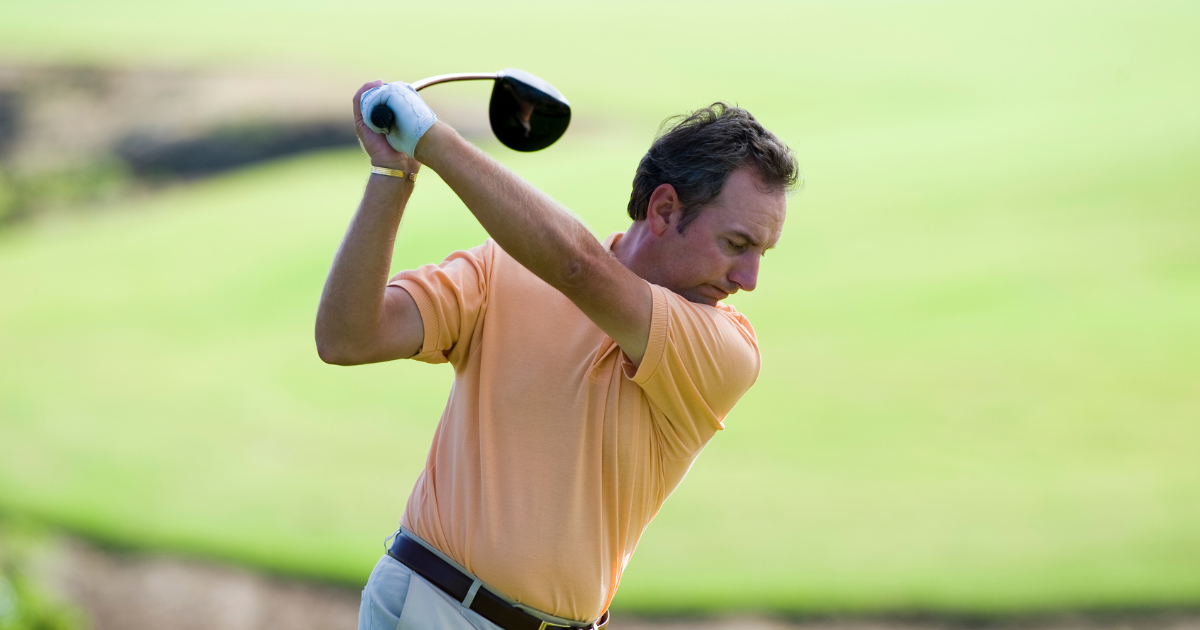
Golf Swing Speeds for Senior Golfers Over 60.
Swing speed is one factor that influences how far we hit a golf ball.
For golfers over 60 there can be a dramatic reduction in swing speed as we get more “experienced”!
There’s approximately a 20mph loss in speed for men and women between the ages of 40 and 60.
However, pro-golf coaches suggest that for the majority of club golfers, regardless of gender, a bigger differentiating factor on distance is the quality of strike and correct technique.
For example an LPGA pro golfer and an average distance male amateur may have very similar swing speeds, but the ladies will hit the ball much further due to the quality of their ball striking.
| Age | Women | Men |
|---|---|---|
| 30 – 40 | 90 mph | 108 mph |
| 41 – 50 | 88 mph | 103 mph |
| 51 – 60 | 73 mph | 98 mph |
| 60+ | 70 mph | 90 mph |
How to Maximise Distance Despite Slower Swing Speeds for Golfers Over 60.
Click “Play” below to watch this video for top tips on how to keep your distance consistant as natural swing speeds slow down.
Average Distance Charts for Golfers 60+: Ladies
For ladies over the age of 60 swing speeds tend to be around 70mph.
Our club distance charts are divided into two age groups which we hope you’ll find useful in benchmarking your own game.
Remember these distances are meant as a guide and show a mid-range distance for each club.
To get a more accurate reading for your own shots you should speak to your club professional.
| Club | Mid Range 60-70 yo | Mid Range 70-80 yo |
|---|---|---|
| Driver | 140–180 yards | 120–160 yards |
| 3 Wood | 120–160 yards | 100–140 yards |
| 5 Wood | 110–145 yards | 80–120 yards |
| Hybrid | 115 – 135 yards | 85 – 115 yards |
| 3 iron | 100–130 yards | 90–130 yards |
| 4 iron | 90–130 yards | 80–120 yards |
| 5 iron | 80–120 yards | 70–110 yards |
| 6 iron | 70–110 yards | 60–100 yards |
| 7 iron | 60–100 yards | 50–90 yards |
| 8 iron | 50–90 yards | 40–80 yards |
| 9 iron | 40–80 yards | 30–70 yards |
| Pitching Wedge | 30–70 yards | 20–60 yards |
| Gap Wedge | 20–60 yards | 10–50 yards |
| Sand Wedge | 10–50 yards | 10–40 yards |
| Lob Wedge | 10 – 40 yards | 10–30 yards |

Average Distance Charts for Golfers 60+: Men
The average swing speed for men over 60 is approximately 90 mph as opposed to 108mph for men aged 30-40.
This reduces how far we hit each club by between 10 and 40 yards as we get into our 60’s and 70’s.
Take a look at these mid-range distance benchmarks and see how you compare with your ownclubs.
We’ve also shown total distance for the PGA Senior Tour Pro’s so you can check your own performance against their average yardages – which are still pretty impressive!
| Club | Mid-Range 60 – 70 yo | Mid-Range 70+ yo | Senior Tour Pro (Averages) |
|---|---|---|---|
| Driver | 200–240 yards | 180–220 yards | 260 – 310 yards |
| 3 Wood | 170–210 yards | 160–190 yards | 230 – 239 yards |
| 5 Wood | 160–190 yards | 150–180 yards | 218 – 226 yards |
| Hybrid | 155 – 175 yards | 200 – 230 yards | 200 – 230 yards |
| 3 iron | 150–180 yards | 140–170 yards | 201 – 208 yards |
| 4 iron | 140–170 yards | 130–160 yards | 192 – 199 yards |
| 5 iron | 130–160 yards | 120–150 yards | 184 – 191 yards |
| 6 iron | 120–150 yards | 110–140 yards | 173 – 180 yards |
| 7 iron | 110–140 yards | 100–130 yards | 163 – 169 yards |
| 8 iron | 100–130 yards | 90–120 yards | 151 – 157 yards |
| 9 iron | 90–120 yards | 80–110 yards | 148 – 185 yards |
| Pitching Wedge | 80–110 yards | 70–100 yards | 129 – 134 yards |
| Gap Wedge | 70–100 yards | 60–90 yards | 124 – 155 yards |
| Sand Wedge | 60–90 yards | 50–80 yards | 112 – 140 yards |
| Lob Wedge | 50 – 65 yards | 40–60 yards | 100 – 135 yards |

5 Ways Senior Golfers Over 60 Can Regain (Or Retain) Distance Off The Tee
So you’ve seen the numbers and read a bit about the reasons why it’s natural for us to drop distance as we age.
But that doesn’t mean you have to sacrifice serious yardage.
With the right adjustments, senior golfers can continue to hit the ball well —or at least maintain their usual distances—well into their 60s, 70s, and beyond.
Here are five expert-backed ways to maximise your distance and accuracy off the tees and fairways.
1. Improve Your Launch Angle With The Right Club Setup
Aging golfers often lose clubhead speed, which results in lower ball speed and less carry.
The fix?
Adjust your driver’s loft to launch the ball higher and increase carry distance.
Many golfers over 60 benefit from a driver loft of 10.5° to 12.5° with a lightweight or “Seniors” shaft.
A properly fitted driver can add 10-15 yards without any extra effort.
The same can be said for long irons which are harder to hit at a slower swing speed.
2. Focus On Flexibility And Rotation Over Raw Power
Strength matters, but flexibility and rotational mobility are the real keys to distance in your later years.
If your backswing is getting shorter, you’re likely losing power.
Work on hip and thoracic spine mobility exercises, and practice a fuller turn to maximize stored energy.
Try taking up alternative low-impact sports like pickleball and padel that help with flexibilty and rotations.
A wider stance and slightly flared lead foot can help increase rotation, giving you more leverage in the swing.

3. Use A Smooth, Efficient Tempo
One of the biggest mistakes senior golfers make is trying to swing harder to compensate for lost distance.
This often leads to tension and inefficiency.
Instead, adopt a smooth, rhythmic tempo—think Ernie Els rather than Bryson DeChambeau.
A slower takeaway and a full release through impact will allow the club to do the work while keeping your swing speed high.
4. Upgrade To A More Forgiving Shaft
If you’re golf clubs are fitted with stiff shafts, it may be time to switch to a shaft with more flex.
Most senior golfers gain distance by transitioning to a regular or senior flex shaft, which helps generate more clubhead speed and a higher launch.
Additionally, a lighter shaft—somewhere in the 50-60g range—can add effortless distance.
In a similar way try swapping your longer irons for hybrids or lofted fairway woods like a 7 wood or even a 9 wood.
5. Maximize Ground Force For Extra Speed
It’s easy to forget that power doesn’t just come from the arms—it starts from the ground up.
The best senior golfers use ground force effectively by maintaining good balance and engaging their legs in the downswing.
Feeling pressure shift into your trail foot on the backswing and then driving through with your lead foot can help you generate more clubhead speed without swinging out of your shoes.
Final Thoughts
Losing a few yards with age is inevitable, but the right equipment choices, improved flexibility, and better use of your body can keep your game competitive.
Focus on efficiency rather than brute strength, and you’ll be surprised how much distance you can still squeeze out of your swing.
Remember the beauty of golf is the handicap system means no matter how far you hit the ball you can still have a competitive, enjoyable game with any other player no matter what age or skill level.
Play your own game and don’t let ego push your shot selection decisions.
The more accurate experienced golfer will win the day most times over the huge hitting young gun!
Mastering Your Game: Distance Charts for Golfers 60+
Senior Golf Distance Charts Based on Experience
At Greencard Golf, we believe that the most enjoyable rounds are played with strategy, not just strength.
We bring over 75 years of combined experience on the world’s most prestigious fairways—from the links of Scotland to the tropical resorts of Mauritius.
We don’t just study data; we see it on the fairways all over the World.
Many of our clients are experienced golfers who have played the game for many years on some of the top courses across the golfing globe.
Because we host 12 global tournaments annually, we have the unique advantage of observing thousands of shots played in friendly competitive conditions.
We have cross-referenced this real-world observation with professional launch monitor data to create the definitive Distance Charts for Golfers 60+.
This is a consatantly developing resource, updated regularly to ensure that as equipment technology evolves, your club selection remains precise.
How We Calibrate Your Distances with our Interactive Calculator
A “standard” generic chart doesn’t work for a golfer who understands the nuances of the game.
To build our Personalised 60+ Golf Distance Calculator, we combined data from the most authoritative sources in the industry:
-
PGA & LPGA Tour Averages (2025/26): To establish the “Gold Standard” of smash factor and efficiency.
-
TPI (Titleist Performance Institute) Research: Utilising specific swing-speed models for golfers in the 60, 70, and 80+ brackets.
-
Equipment Manufacturer Specs: Adjusting for the “stronger” lofts found in modern game-improvement irons.
-
The Greencard Community: Real-world data from our active travel community, capturing how experienced amateur golfers of all handicap levels actually perform under tournament pressure.
The Physics of the Fairway: Why Your Environment Matters
A 7-iron in the thin air of the South African Highveld performs very differently than one at sea level in Florida.
Our baseline charts assume a Standard Baseline (70°F, Sea Level, Calm Winds).
To give you a more realistic feel for your yardages, our distance calculator makes allowances for these environmental variables:
- Temperature: Golf balls lose elasticity in the cold. Subtract 2 yards for every 10°F drop below 70°F.
-
The Fairway Factor: On lush, resort-style fairways, your “Total” distance will migrate closer to your “Carry” distance. This is why knowing your carry number is the secret to lower scores.
- Altitude: Gain approximately 2% more distance for every 1,000ft of elevation.
Top Tips for Clubs to Carry & Golf Ball to Play for Golfers 60+
Strategic advice from our tournament director and Golf Pro Panel.
As swing speeds naturally move into the 70–90 mph range, the physics of the game changes.
To maintain a luxury experience on the course, your equipment must do the heavy lifting for you.
1. Embrace the “High Woods” Many senior golfers struggle with the low launch angles of 3, 4 and even 5 irons.
Our Pro Panel strongly recommends replacing these clubs with 7-woods and 9-woods rather than hybrids.
These clubs offer a larger hitting area and deeper Centre of Gravity (CG), allowing for a higher launch and a “soft landing” on the green.
Read more: How far should you hit a 7-wood? Our amateur guide.
2. Soft Ball Technology If you are a mid to high handicap golfer over 60 and still playing a high-compression “Tour” ball like a Pro V1, you may be losing significant distance.
Modern soft-compression technology allows golfers with moderate to slow swing speeds to fully compress the core, resulting in higher ball speeds – leading to further distances and a better feel around the greens – leading to better scoring on every hole.
Compare the best: Top Pro V1 Alternatives for Golfers 50+
FAQ’s: Optimising Distance for Senior Golfers
As we get older our mobility, strength and flexibility reduce which impacts on swing speed and shot distance.
Distance loss is primarily driven by a reduction in fast-twitch muscle fiber and flexibility, which lowers clubhead speed.
Additionally, many seniors use golf club shafts that are too stiff. For golfers over 60 changing to more flex in their club shafts will drive greater “kick” required to generate velocity.
Take a look at the answer to our question below for our Golf Pro Panel recommendations for the best golf club shaft choice for senior golfers.
The short answer is “Yes!”.
Graphite shafts are significantly lighter than steel, allowing for increased swing speed.
They also dampen vibrations, which is crucial for golfers dealing with arthritis or joint sensitivity in their hands and elbows.
The average male golfer over 60 typically hits a 7-iron between 120 and 140 yards.
For women in the same age bracket, the average is between 80 and 110 yards.
However, using a personalised calculator like ours is vital, as handicap and fitness levels can cause these numbers to vary by 30+ yards.
Golfers with swing speeds under 90 mph can often gain 5 to 10 yards of total distance by switching to a low-compression ball like the Srixon Soft Feeel.
These balls stay on the clubface slightly longer, reducing spin and increasing launch height.
For these reasons golfers over 60 often find when they switch away from the highly popular “Tour” golf balls, they can hit longer clubs further and wedges with more control leading to lower scoring and more enjoyment.
Generally, yes.
This is mainly down to the club design benefits of the 7 wood over hybrids.
A 7-wood has a larger head and a more forgiving sole than a hybrid.
For most golfers over 60, the 7-wood provides a higher flight and stops faster on the green, making it the ultimate “utility” club for long approaches.
We recommend recalibrating your distances at least twice a year.
Physical fitness changes and new equipment releases like the new “10k MOI” large head drivers such as the PING G440 K.
This allows maximum forgiveness for off-center contacts and can shift your numbers significantly over a six-month period.
Absolutely.
For a golfer over 60 who may already be at the edge of clearing a hazard, the 10% distance boost in high-altitude locations (like certain courses in Colorado or the Alps) can be the difference between a birdie and a lost ball!
Our Personlised Calculator Tool will give you numbers for both Carry and Total distances.
This data is as accurate as we can make it for your individual characteristics.
To test these distances we recommend using a launch monitor (like Trackman or GCQuad).
If that isn’t available, hit 10 balls with a specific club on a calm day at a flat range, discard the two shortest and two longest, and average the rest based on where the ball first lands.
Popular Distance Resources from Greencard Golf
Detailed Distance Guides:
- Our New Interactive Golf Distance Calculator
- Complete Golf Distance Charts (All Demographics)
- Golf Distance Charts for Female Golfers
- Golf Distance Charts Personalised by Handicap
Individual Club Guides:
Disclosure: This post may contain affiliate links, meaning if you decide to make a purchase via our links, we may earn a commission at no additional cost to you. Prices quoted correct at time of publication.
YOU MIGHT ALSO BE INTERESTED IN…